









Don’t navigate your rideshare accident alone; Contact National Injury Help today for a free consultation and let our experienced attorneys fight for your rightful compensation.
Being injured in a rideshare accident in Kirkland often triggers a chain reaction that goes far beyond the crash itself. Emergency transport, diagnostic testing, surgeries at EvergreenHealth Kirkland, Overlake Medical Center, or Harborview, ongoing rehabilitation, and weeks or months away from work can quickly destabilize your finances and your routine. At the same time, you are often forced to deal with multiple insurance carriers, each operating with different rules, coverage limits, and incentives.
Unlike traditional car accidents, rideshare claims involve companies that deliberately structure their business model to distance themselves from direct responsibility. Uber and Lyft classify drivers as independent contractors, not employees, which shifts the legal analysis toward app status, policy layers, and Washington-specific liability law. Without experienced guidance, injured victims are often left navigating a system designed to protect corporate interests.
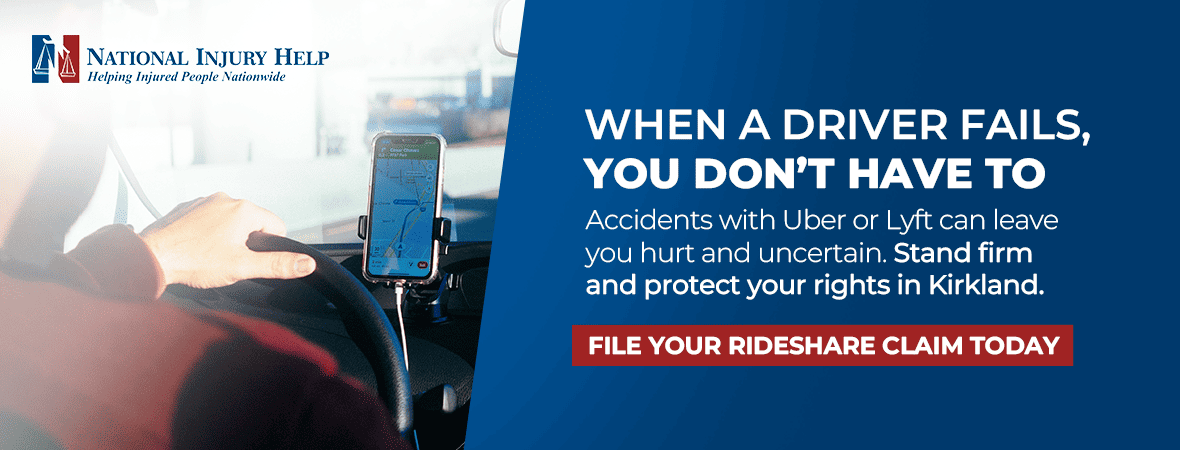
National Injury Help assists injured riders, drivers, and third parties in Kirkland by clarifying responsibility, preserving evidence, and pursuing full financial recovery. Their attorneys understand Washington law, local traffic patterns, and the tactics used by rideshare insurers to limit payouts.
No Fee Guarantee: You pay nothing unless we win your case and secure compensation for you.
Call for a Free Consultation
What Constitutes a Rideshare Accident?
A rideshare accident refers to any motor vehicle collision involving a transportation network company such as Uber or Lyft. While that may sound straightforward, these cases are legally complex because responsibility may shift depending on the driver’s activity at the moment of impact.
Coverage varies based on whether the driver was:
- Logged into the app, but not yet matched with a ride
- Actively driving to pick up a passenger
- Transporting a passenger during an active trip
Each of these stages activates a different insurance layer, ranging from personal auto coverage to contingent liability policies and, in many cases, a $1 million commercial policy. Establishing whether the app was active and what phase of the trip the driver was in is often the central dispute in these cases.
Rideshare collisions frequently result in severe injuries, including traumatic brain injuries, spinal cord damage, fractures, internal bleeding, and long-term psychological conditions such as anxiety or post-traumatic stress. Determining the app status is not a technicality; it is the gateway to identifying which insurer is financially responsible. National Injury Help has extensive experience analyzing app data and insurance timelines to uncover the full scope of available coverage.
Why Do Rideshare Accidents Happen So Often in Kirkland?
Rideshare crashes are rarely unavoidable. In most cases, they result from a combination of human error, system design, and environmental conditions. Kirkland’s rapid growth and commuter-heavy infrastructure amplify these risks.
Frequent Causes of Rideshare Collisions
App-driven distraction
Rideshare drivers must constantly interact with their phones. Accepting ride requests, following GPS directions, adjusting routes, and communicating with passengers divide attention and reduce reaction time.
Excessive fatigue
Many drivers work extended shifts, drive late at night, or operate on multiple platforms simultaneously. Fatigue slows reflexes and increases the likelihood of judgment errors.
Speeding and aggressive maneuvers
Financial incentives encourage drivers to complete more trips in less time. This often results in speeding, abrupt lane changes, unsafe turns, and failure to yield.
Unfamiliarity with local roads
Drivers who are new to Kirkland may struggle with complex intersections, one-way streets, or sudden merges, particularly near waterfront areas or residential zones.
Impaired driving
Alcohol, drugs, or even prescription medications can impair perception, coordination, and decision-making.
Unsafe pickup and drop-off behavior
Stopping suddenly in traffic lanes, double-parking, or opening doors into bike lanes near downtown Kirkland or tech campuses can cause serious secondary collisions.
Weather-related hazards
Rain, fog, and slick pavement near Lake Washington significantly reduce traction and visibility.
Vehicle wear and tear
High-mileage vehicles with neglected brakes, tires, or lighting systems pose additional risks.
Identifying which of these factors contributed to your crash is essential for establishing fault and unlocking the correct insurance coverage.
How Does Kirkland’s Infrastructure Increase Rideshare Risk?
Kirkland’s layout creates a unique risk profile for rideshare traffic. The city combines dense commuter corridors, residential neighborhoods, commercial districts, and waterfront attractions, all within a relatively compact area.
High-risk features include:
- Heavy commuter traffic along I-405, SR-520, and Lake Washington Boulevard
- Congested downtown areas with limited curb space for pickups
- Tech campuses are generating a surge in traffic during peak hours
- Narrow residential streets in areas like Juanita and Finn Hill
- Waterfront fog and rain are reducing visibility
- Weekend congestion near Marina Park, Totem Lake, and dining districts
Local insight allows attorneys to connect road design, traffic flow, or weather conditions directly to the cause of a collision. National Injury Help uses this knowledge to strengthen liability arguments and anticipate defense strategies.
How Do You Prove Fault in a Rideshare Injury Claim?
Establishing liability in a rideshare case requires more than demonstrating that a crash occurred. You must show how specific negligent actions caused your injuries.
Key evidence may include:
- Photos of the scene, vehicle damage, and road conditions
- Police or Washington State Patrol reports
- App usage logs, GPS data, and telematics
- Driver phone records and communication history
- Vehicle maintenance and inspection records
- Witness testimony and nearby security footage
- Expert reconstruction analysis
- Medical documentation linking injuries to the collision
Liability can fall on the driver, the rideshare company for negligent oversight, or a third-party motorist. National Injury Help knows how to build evidence chains that can withstand insurer scrutiny and courtroom challenges.
What Are Economic and Non-Economic Damages Under Washington Law?
Washington law recognizes that injuries affect both finances and quality of life.
Economic Losses
Economic damages include all measurable costs, such as:
- Emergency treatment, hospitalization, surgery, and rehabilitation
- Ongoing medical care and future treatment needs
- Lost wages and diminished earning capacity
- Property damage to vehicles and personal belongings
For Kirkland professionals in tech or specialized fields, income loss calculations can be substantial. Washington does not impose caps on economic damages, making accurate documentation critical.
Non-Economic Harm
Non-economic damages address losses that do not come with invoices:
- Physical pain and ongoing discomfort
- Emotional distress, anxiety, or depression
- Loss of enjoyment of life
- Permanent impairment or disfigurement
- Loss of companionship or support
- Wrongful death damages for surviving families
King County courts rely on medical opinions, assessments from therapists, and testimony from family members to evaluate these impacts. National Injury Help creates detailed narratives about damages that reflect the complete human cost of an injury.
How Do Early Decisions Affect Your Claim?
The steps you take immediately after a rideshare crash can significantly influence the outcome of your case.
- Seek prompt medical evaluation, even if symptoms seem minor
- Follow all treatment recommendations consistently
- Keep copies of medical bills, prescriptions, and test results
- Save ride receipts, screenshots, and app communications
- Write down your recollection of the incident while it is fresh
- Avoid posting about the accident online
- Consult National Injury Help before speaking with insurers
Early action preserves evidence and limits insurers’ ability to dispute causation or severity.
What Are Settlements, Litigation, and Trial Readiness?
Most rideshare cases resolve through settlement, but substantial settlements are driven by trial preparedness. Insurers are more likely to negotiate fairly when they know your legal team is ready to litigate.
If negotiations fail, filing suit in King County Superior Court can compel disclosure of internal data, safety records, and driver history. National Injury Help prepares each case as if it will go to trial, even when a settlement is likely.
Kirkland’s Growth and the Rise of Rideshare Exposure
Kirkland’s population growth and commercial expansion have increased reliance on Uber and Lyft. Tech campuses, retail hubs, and waterfront attractions generate constant demand.
With that growth comes increased risk: congested roads, rushed drivers, and unsafe pickup locations. Legal accountability plays a critical role in encouraging safer corporate practices.
What To Do After a Rideshare Crash in Kirkland
After a rideshare accident, take the following steps:
- Call 911 and request police and medical assistance
- Seek immediate medical care
- Photograph vehicles, injuries, and the rideshare app screen
- Exchange driver and app information
- Collect witness contact details
- Avoid admitting fault
- Preserve receipts, screenshots, and damaged items
- Notify your insurer without giving recorded statements
- Follow all medical instructions and document your recovery
Dealing With Uber and Lyft Insurance Carriers
Rideshare insurers move quickly after accidents, often attempting to limit exposure. You may encounter:
- Early requests for recorded statements
- Settlement offers that ignore future care or lost income
- Arguments about shared fault or unavoidable conditions
National Injury Help handles all insurer communication and negotiations to protect your interests.
Jurisdiction and Out-of-State Corporations
Although Uber and Lyft are headquartered elsewhere, Washington courts can assert jurisdiction when crashes occur locally. National Injury Help manages jurisdictional strategy, service of process, and venue selection.
Technology, Data, and Emerging Safety Issues
Modern rideshare vehicles may include dashcams, braking alerts, fatigue monitoring, and telematics systems. When these systems are disabled or ignored, liability concerns arise.
At National Injury Help, our network of experienced Kirkland rideshare accident lawyers requests app logs and vehicle data to determine whether safety technology was active at the time of the crash.
Coordinating Medical Care and Legal Strategy
Effective coordination between medical providers and legal counsel strengthens both recovery and case value. National Injury Help assists with:
- Provider lien negotiations
- Detailed physician narrative reports
- Long-term care planning
- Independent medical evaluations
Clear documentation turns medical reality into legally recoverable damages.
Why Does Local Representation Matter in Kirkland?
Local attorneys understand traffic patterns, courts, and investigative resources. That familiarity improves efficiency and strengthens claims.
National Injury Help’s local network offers insight into:
- Kirkland road design and congestion
- King County judges and procedures
- Local accident reconstruction experts
- Tech campus traffic behavior
Frequently Asked Questions
- How long do I have to file a rideshare accident claim in Washington?
Generally, three years from the crash date. Claims involving government entities require earlier notice. Contact National Injury Help immediately to ensure you don’t miss critical deadlines.
- What if I was partly at fault?
You can still recover damages under pure comparative negligence, reduced by your fault percentage. National Injury Help’s attorneys know how to minimize fault attributions.
- Do I need a police report?
A police or Washington State Patrol report helps, but isn’t mandatory. App data, witness statements, and photos can prove liability.
- Can I recover if the rideshare driver wasn’t ticketed?
Indeed, it is essential to note that civil negligence operates independently of any criminal citations or charges. The two concepts are distinct and can lead to separate legal consequences.
- What if the app was off?
Only the driver’s personal insurance applies when the rideshare app is off.
- What if I was a passenger?
Uber and Lyft’s $1 million policy generally covers you. National Injury Help can help you access this coverage.
- How much is my case worth?
Value depends on your medical needs, lost income, and long-term impact. National Injury Help offers free case evaluations.
- Do these cases usually settle?
Most do, once liability and damages are well-documented by experienced counsel.
- What if I can’t afford a lawyer?
National Injury Help operates on a contingency fee basis, which means that individuals only pay for our services if we successfully secure a recovery on their behalf. This approach ensures that everyone has access to quality legal representation without the burden of upfront costs.
- What if my loved one was killed in a rideshare crash?
Families can bring wrongful death and survival actions for financial and emotional losses. The compassionate attorneys at National Injury Help can guide you through this challenging process.
- Should I talk to the rideshare insurer?
Give only basic facts. Decline recorded statements and refer them to your lawyer at National Injury Help.
- Can I claim PTSD or anxiety?
Yes. Washington law recognizes emotional and psychological injuries, and National Injury Help knows how to document and recover for these damages.
- What if the driver fled the scene?
You may claim under uninsured motorist coverage or the platform’s UM policy if active. National Injury Help will explore all available recovery options.
Do Not Face a Rideshare Accident Claim Alone
At our firm, we understand that a rideshare accident can disrupt your life in an instant. The burden of medical bills, insurance complexities, and the emotional toll can be overwhelming. You don’t have to navigate this challenging time alone; our dedicated team is here to support you every step of the way.
Our skilled Kirkland rideshare accident lawyers possess the experience necessary to assist you in gathering crucial evidence, negotiating with insurance companies, and advocating for your rights. Whether your case involves Uber, Lyft, or a complex web of insurers, we are well-equipped to handle it. We focus on the details, from retrieving app logs to effectively litigating in King County Superior Court, ensuring that you can concentrate on what truly matters: your healing.
We believe that the key to a strong case lies in promptly preserving evidence and initiating your claim. Our attorneys work diligently to build a solid foundation for your case, utilizing our resources and knowledge to advocate fiercely on your behalf. Your peace of mind is our priority, and we strive to alleviate your stress during this challenging time.
If you or a loved one has been involved in a rideshare accident, please reach out to us today. Our firm is committed to providing you with personalized support and a comprehensive strategy to pursue the compensation you deserve. Contact National Injury Help today for a free consultation, and let us help guide you through the recovery process.