











Injured in a truck accident in Redmond? Let National Injury Help connect you with a Redmond truck accident lawyer today.
Understanding Truck Accidents in Redmond
- WA-520, SR-202, and I-405 carry heavy commercial truck traffic through Redmond
- Washington law (RCW 4.16.080) requires filing personal injury claims within three years
Redmond’s position between Seattle, Bellevue, and the Eastside creates substantial commercial truck traffic. Highways, including WA-520, SR-202, and I-405, serve as major shipping corridors. Tractor-trailers, delivery trucks, and commercial vehicles travel these routes daily, creating collision risks.
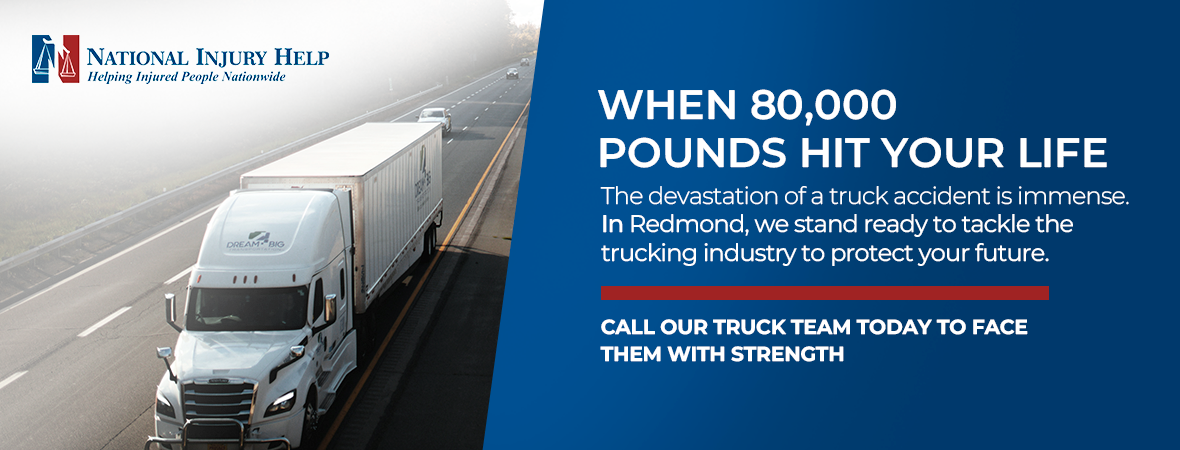
Truck accidents differ from standard car crashes due to vehicle size, weight, and commercial operations. When trucks weighing up to 80,000 pounds collide with passenger vehicles, the force produces severe injuries. Multiple vehicles often become involved in chain-reaction crashes.
Commercial trucking operations involve multiple parties: drivers, companies, cargo loaders, and maintenance providers. Determining liability requires investigating which parties’ negligence contributed to accidents. Federal Motor Carrier Safety Administration (FMCSA) regulations and Washington traffic laws both govern truck operations, creating complex legal issues.
No Fee Guarantee: You pay nothing unless we win your case and secure compensation for you.
Call for a Free Consultation
Common Causes of Truck Accidents
Driver Fatigue
- FMCSA hours-of-service rules limit driving time, but violations occur
- Tired drivers have slower reaction times and impaired judgment
Driver fatigue causes many truck accidents. Federal regulations limit drivers to 11 hours of driving after 10 consecutive hours off duty. Despite these rules, some drivers or companies violate limits to meet delivery schedules. Fatigued drivers exhibit slower reaction times, reduced attention, and impaired decision-making.
Driver logs, electronic logging device (ELD) data, and delivery schedules document hours worked. Violations of hours-of-service rules establish negligence in accident claims. Medical records showing driver fatigue at the accident support liability arguments.
Distracted Driving
- Phone use, GPS adjustments, and eating divert driver attention
- Brief distractions become dangerous given trucks’ extended stopping distances
Distracted driving occurs when truck drivers use phones, adjust navigation systems, or handle other tasks while driving. Even momentary distraction proves dangerous because loaded trucks require 200-300 feet to stop at highway speeds: twice the distance of passenger vehicles.
Cell phone records showing calls or texts during the accident time prove distraction. Witness statements describing driver behaviour and dashcam footage establish that drivers failed to maintain attention. These violations of basic traffic safety create liability.
Poor Vehicle Maintenance
- Brake failures, tire blowouts, and steering problems cause crashes
- FMCSA regulations require regular inspections and maintenance
Trucks require regular maintenance to operate safely. Brake system failures, tire blowouts, and steering malfunctions can make trucks uncontrollable. FMCSA regulations mandate pre-trip inspections, annual inspections, and maintenance records documenting all repairs.
Maintenance records, inspection reports, and mechanical examinations reveal whether companies followed required maintenance schedules. Missing inspections or deferred repairs establish negligence when mechanical failures cause accidents.
Improper Cargo Loading
- Overloaded or unbalanced loads affect truck handling
- Unsecured cargo can shift, causing jackknife accidents or rollovers
Cargo must be properly loaded, balanced, and secured. Overloaded trucks exceed legal weight limits and require longer stopping distances. Unbalanced loads make trucks difficult to control during turns. Unsecured cargo can shift during transit, causing trucks to tip or jackknife.
Loading manifests, weight station records, and cargo securement inspections document whether loads complied with regulations. Photos of accident scenes showing shifted or spilled cargo prove improper loading contributed to crashes.
Speeding and Aggressive Driving
- Excessive speed reduces control and increases crash severity
- Washington traffic laws set lower speed limits for commercial vehicles
Speeding contributes to truck accidents on highways, including SR-520 and I-405. Commercial vehicles traveling too fast for conditions cannot stop or maneuver safely. Aggressive driving, including tailgating, unsafe lane changes, and failure to yield, creates additional collision risks.
Traffic citations, black box data showing vehicle speeds, and accident reconstruction calculations prove speeding. Washington law requires trucks to observe posted limits and adjust speed for weather and traffic conditions.
Weather and Road Conditions
- Rain creates slick surfaces, reducing tire traction
- Fog reduces visibility on local highways
Redmond’s frequent rain creates dangerous driving conditions for trucks. Wet pavement reduces tire traction, increasing stopping distances. Fog reduces visibility, making it difficult to see traffic ahead. While weather affects conditions, drivers remain responsible for adjusting speed and following distance.
Weather reports from accident times and road condition documentation establish whether drivers failed to adjust for conditions. Continuing to drive at unsafe speeds during storms constitutes negligence.
Common Injuries From Truck Accidents
Traumatic Brain Injuries
- Head trauma from impacts or airbag deployment
- Symptoms include headaches, memory problems, and cognitive impairment
Truck accidents produce forces causing traumatic brain injuries even without direct head strikes. Rapid acceleration-deceleration shakes the brain inside the skull. Concussions represent mild TBIs, causing temporary confusion and headaches. Severe brain injuries produce lasting cognitive, emotional, and physical impairments.
CT scans, MRIs, and neurological examinations document brain injuries. Neuropsychological testing measures cognitive deficits affecting memory, concentration, and executive function. This evidence supports compensation for medical treatment and lost earning capacity.
Spinal Cord Injuries
- Neck and back trauma can cause partial or complete paralysis
- These catastrophic injuries require lifetime care
Spinal cord damage represents devastating truck accident injuries. Depending on injury location and severity, victims may lose sensation and mobility below injury sites. Complete spinal cord injuries cause total paralysis. Partial injuries produce varying degrees of weakness and sensory loss.
MRI scans reveal spinal cord damage. Neurosurgical evaluations establish whether injuries are complete or incomplete and project long-term functional limitations. Life care planners calculate lifetime costs for wheelchairs, home modifications, and attendant care.
Fractures and Orthopedic Injuries
- Broken bones throughout the body require surgery and rehabilitation
- Severe fractures may cause permanent limitations
Truck collision forces cause fractures in arms, legs, ribs, pelvis, and facial bones. Complex fractures require surgical repair with pins, plates, or screws. Some fractures heal with permanent limitations affecting mobility and work capacity.
X-rays, CT scans, and surgical reports document fracture severity. Orthopedic specialists evaluate whether injuries cause permanent impairments. Vocational experts assess how limitations affect the ability to perform previous employment.
Internal Injuries
- Organ damage and internal bleeding require immediate treatment
- Delayed symptoms make a thorough medical evaluation critical
Blunt force trauma causes internal organ damage and bleeding. Liver, spleen, kidney, and lung injuries produce life-threatening complications. Some internal injuries produce delayed symptoms, making immediate, thorough medical evaluation critical after truck accidents.
CT scans and ultrasounds detect internal injuries. Emergency surgery records and hospitalisation documents establish injury severity and treatment requirements. Long-term complications support claims for future medical expenses.

Burn Injuries
- Truck fires and chemical spills cause severe burns
- These injuries require specialized treatment and cause permanent scarring
Truck accidents sometimes cause fires or chemical spills, producing burn injuries. Fuel tank ruptures, electrical fires, and hazardous material spills create severe burns requiring specialized treatment. Severe burns cause permanent scarring and disfigurement.
Burn unit records, plastic surgery reports, and photographs document injury extent. Life care planners project costs for skin grafts, reconstructive surgeries, and scar treatment over victims’ lifetimes.
Determining Liability in Truck Accidents
Truck Driver Liability
- Violations of traffic laws and FMCSA regulations establish driver negligence
- Personal injury claims pursue compensation from drivers and their insurers
Truck drivers face liability when their negligent actions cause accidents. Speeding, distracted driving, hours-of-service violations, and failure to maintain control all constitute negligence. Driver liability forms the foundation of most truck accident claims.
Traffic violation reports, ELD data on hours-of-service issues, and witness statements demonstrate driver negligence. Additionally, black box data from truck records includes speed, braking, and other operational details that support liability claims.
Trucking Company Liability
- Companies face vicarious liability for employee driver negligence
- Direct negligence includes inadequate training, poor maintenance, and unrealistic schedules
Trucking companies can be held liable under the legal principle of respondeat superior when their employee drivers cause accidents while performing work-related activities. Additionally, these companies may face direct liability if their own negligence contributes to the accidents. Factors such as insufficient driver training, failure to conduct thorough background checks, and pressure to meet unrealistic deadlines can lead to company liability.
Company safety records, driver qualification files, and internal communications about delivery schedules establish corporate negligence. FMCSA inspection reports documenting company violations support liability claims.
Cargo Loader Liability
- Improper loading, unbalanced weight distribution, and inadequate securement cause accidents
- Cargo companies have their own liability that is distinct from the responsibilities of the driver and the trucking company
Cargo loading companies are responsible when improper loading contributes to accidents. Issues such as overloading, unbalanced weight distribution, and inadequate securing of cargo can make trucks difficult or impossible to control safely. These loading errors can lead to rollovers, jackknife accidents, and cargo spills.
Loading documents, weight station records, and post-accident cargo inspections can provide evidence of loading negligence. Additionally, training records and safety procedures from cargo companies help determine whether proper protocols were followed.
Maintenance Provider Liability
- Negligent repairs or missed safety issues create liability
- Independent maintenance companies face claims separate from trucking companies
Independent maintenance providers face liability when negligent repairs or inspections contribute to accidents. Failing to identify worn brakes, damaged tires, or steering problems during inspections constitutes negligence. Improper repairs that cause mechanical failures also create liability.
Maintenance records, inspection reports, and mechanic certifications document the service provided. Expert mechanical examinations reveal whether proper standards were followed and whether maintenance failures caused accidents.
Parts Manufacturer Liability
- Defective brakes, tires, and other components cause accidents
- Product liability laws allow claims against manufacturers
Vehicle and parts manufacturers face strict product liability when defective components cause accidents. Brake system failures, tire defects, and steering mechanism malfunctions create dangers. Washington product liability law (RCW 7.72) allows recovery without proving manufacturer negligence, only that the products were defective and caused injuries.
Similar incident reports, manufacturing records, and recalls establish product defects. Engineering experts analyze failed components to determine whether design or manufacturing defects existed.
Government Entity Liability
- Poor road maintenance and defective traffic control devices contribute to accidents
- Claims against government agencies require notice within 60-120 days
Cities, counties, and state agencies maintain roads, bridges, and traffic control devices. Potholes, missing guardrails, malfunctioning signals, and inadequate signage sometimes contribute to truck accidents. Government entities face liability when they knew or should have known about hazards and failed to address them.
Prior incident reports, maintenance records, and inspection documents prove government knowledge of hazards. Claims against government entities require formal notice under RCW 4.92 and RCW 4.96 within strict deadlines, typically 60 to 120 days. Missing notice deadlines bars claims regardless of government negligence.
Washington Truck Accident Laws
Comparative Fault System
- RCW 4.22.005 allows recovery even when victims share accident responsibility
- Courts assign fault percentages affecting compensation amounts
Washington applies pure comparative fault to truck accident claims. Courts assign each party a fault percentage based on their contribution to accidents. A victim found 20% at fault recovers 80% of the total damages from other liable parties. This system allows recovery even when victims share some responsibility.
Comparative fault affects settlement negotiations and trial strategies. Insurance companies attempt to maximize victim fault percentages to reduce payments. Evidence clearly establishing other parties’ negligence becomes critical for limiting victim fault allocation.
Hours-of-Service Regulations
- FMCSA rules limit driving time to prevent fatigue
- Violations establish negligence in accident claims
Federal hours-of-service regulations limit truck drivers to 11 hours driving after 10 consecutive hours off duty. Drivers cannot drive beyond the 14th consecutive hour after coming on duty. These rules prevent fatigue-related accidents.
Electronic logging devices track driving hours, creating verifiable records. Hours-of-service violations prove drivers and companies breached safety duties. These violations establish negligence in accident claims.
Vehicle Maintenance Requirements
- Annual inspections and regular maintenance are mandatory
- FMCSA regulations establish specific maintenance standards
FMCSA regulations require yearly vehicle inspections, pre-trip inspections, and maintenance records documenting all repairs. Brake systems, tires, lights, and steering mechanisms must meet safety standards. Companies must maintain records proving compliance.
Missing inspections or maintenance records create presumptions of negligence. Mechanical failures prove particularly significant when records show deferred maintenance or skipped inspections.
Commercial Driver’s License Requirements
- CDL holders must meet medical and competency standards
- Disqualifying violations affect company liability
Commercial truck drivers must maintain valid CDLs with appropriate endorsements. They must pass medical examinations and cannot drive with disqualifying violations, including DUI convictions. Companies must verify driver qualifications before employment.
Driver qualification files document whether companies properly vetted employees. Hiring drivers with disqualifying violations or failing to maintain current medical certifications establishes company negligence.
Insurance Requirements
- Commercial trucks must carry higher liability coverage than passenger vehicles
- Minimum coverage ranges from $750,000 to $5 million, depending on cargo
Washington requires commercial carriers to maintain substantially higher insurance coverage than passenger vehicle drivers. Minimum coverage depends on truck type and cargo, typically $750,000 for general freight and up to $5 million for hazardous materials.
These higher limits provide compensation resources for severe injury claims. Identifying all applicable insurance policies, driver personal insurance, company liability coverage, and excess policies maximizes available compensation.
Statute of Limitations
- RCW 4.16.080 requires filing lawsuits within three years
- Government entity claims require notice within 60-120 days
Washington law establishes strict deadlines for filing truck accident lawsuits. The three-year statute of limitations begins on accident dates. Missing this deadline permanently eliminates the right to pursue compensation through the courts.
Claims against government entities require even shorter notice periods. Formal notice to appropriate agencies within 60 to 120 days precedes filing lawsuits. Early legal consultation ensures compliance with all deadlines.
Recoverable Compensation
Medical Expenses
- Emergency care, hospitalization, surgery, and rehabilitation
- Future medical needs, including therapy, medications, and assistive devices
Medical expenses form a significant portion of truck accident compensation. Emergency treatment at EvergreenHealth Kirkland or Overlake Medical Center, hospitalization, surgery, and initial recovery create immediate costs. Physical therapy, occupational therapy, and speech therapy address ongoing rehabilitation needs.
Severe injuries require projecting future medical needs. Physicians provide opinions about anticipated treatment requirements. Life care planners calculate lifetime medical costs, accounting for inflation and changing needs as victims age.
Lost Income and Earning Capacity
- Wages missed during recovery periods
- Reduced future earnings from permanent disabilities
Truck accident injuries prevent work during recovery. Pay stubs, tax returns, and employer letters establish pre-accident earnings and document lost wages. Compensation includes regular pay, overtime, bonuses, and benefits lost during recovery.
Permanent injuries limiting work capacity require a vocational expert evaluation. These specialists assess whether victims can return to their previous employment or must accept lower-paying positions. Economic experts calculate present values of lifetime earnings losses, accounting for career progression and retirement.
Pain and Suffering
- Physical pain, emotional distress, and reduced quality of life
- Permanent disabilities significantly increase non-economic damages
Non-economic damages compensate for losses without specific dollar values. Physical pain from injuries, emotional distress including depression and anxiety, and inability to enjoy previous activities all warrant compensation. Permanent disabilities preventing participation in hobbies, sports, or social activities represent measurable quality-of-life losses.
Medical expert testimony, mental health evaluations, and family statements establish non-economic damage. Washington does not cap non-economic damages, allowing juries to fully consider injury impacts on victims’ lives.
Property Damage
- Vehicle repair or replacement costs
- Damaged personal property, including electronics and belongings
Vehicle damage represents obvious accident losses. Repair estimates from certified mechanics establish costs to restore damaged vehicles. When repair costs exceed vehicle values, compensation includes fair market values before accidents.
Personal property damaged in accidents qualifies for compensation. Phones, laptops, glasses, and other items destroyed during crashes create compensable losses. Receipts or replacement cost estimates support property damage claims.
Wrongful Death Damages
- RCW 4.20.010 allows family members to pursue death claims
- Compensation includes funeral costs, lost support, and loss of companionship
Fatal truck accidents enable surviving family members to pursue wrongful death claims. Spouses, children, and parents can recover funeral and burial expenses, loss of financial support the deceased would have provided, and loss of companionship, guidance, and affection.
Economic experts calculate lost lifetime earnings, benefits, and household services. Testimony from family members, friends, and clergy establishes emotional losses and the deceased’s family role. These claims address both the financial and emotional impacts of losing loved ones.
Common Challenges
Insurance Company Tactics
Insurance companies routinely challenge truck accident claims. They dispute liability by arguing that victims caused accidents or that multiple parties share fault. They question injury severity, suggesting conditions are less severe than claimed or resulted from pre-existing problems. They offer quick settlements before victims understand the full extent and future needs.
Comprehensive documentation counters these tactics. Complete medical records, expert opinions, and thorough accident investigation establish both liability and damages. Attorneys negotiate using documented evidence rather than accepting inadequate initial offers.
Complex Multi-Party Liability
Truck accidents involve multiple potentially liable parties: drivers, companies, cargo loaders, maintenance providers, and manufacturers. Determining each party’s contribution requires thorough investigation and expert analysis. Insurance companies dispute which policies apply and the coverage amounts.
At National Injury Help, we work with experienced attorneys to investigate all aspects of truck operations to identify all liable parties. They pursue claims against all applicable insurance policies to maximize compensation. When multiple parties share fault, Washington’s comparative fault system allows recovery from each party based on their respective percentages.
Treatment Gaps and Delayed Symptoms
Victims who delay treatment or miss appointments face challenges proving injury severity. Insurance companies use treatment gaps to argue that injuries were not serious or resulted from other causes. Some truck accident injuries produce delayed symptoms, creating additional documentation challenges.
Consistent medical care and complete documentation prevent these arguments. Following prescribed treatment plans demonstrates injury seriousness. Documenting delayed symptoms as they emerge connects them to original accidents, supporting compensation claims.
Evidence Preservation
Critical evidence disappears quickly after truck accidents. Trucking companies investigate immediately to build defenses. Electronic logging devices may be reset. Maintenance records can be lost. Witness memories fade. Physical evidence at scenes disappears.
Early attorney involvement preserves evidence through spoliation letters requiring parties to maintain records. Prompt investigation photographs scenes, interviews witnesses, and collects documents before they disappear. This evidence proves essential during settlement negotiations and trials.
Taking Action After a Truck Accident
At National Injury Help, we understand the challenges that follow a truck accident in Redmond. The immediate medical needs that arise, paired with the long-term financial burdens, can feel overwhelming. That’s why we are dedicated to guiding our clients through this difficult time, ensuring that they receive the medical treatment necessary for recovery while simultaneously building robust documentation to support their compensation claims.
Our team of experienced attorneys is here to offer you personalized legal consultation following an accident. We prioritize the preservation of crucial evidence and work diligently to identify all parties liable for your injuries. With an in-depth understanding of Washington’s comparative fault system, FMCSA regulations, and insurance requirements, we protect your legal rights every step of the way.
We believe that pursuing justice should not come with additional financial stress. That’s why we work on a contingency fee basis, meaning you don’t pay us unless we secure compensation for you. This allows injury victims to focus on healing while we handle the complexities of their cases without any upfront legal costs.
If you or a loved one has been involved in a truck accident in Redmond, don’t hesitate to reach out. Contact National Injury Help today for a confidential case evaluation, and let us discuss your specific circumstances and the legal options available to you. Your path to recovery and justice starts with us.