









Don’t face the aftermath of a motorcycle accident alone; Contact National Injury Help today for a free consultation and let our experienced Federal Way motorcycle accident lawyers fight for your rights.
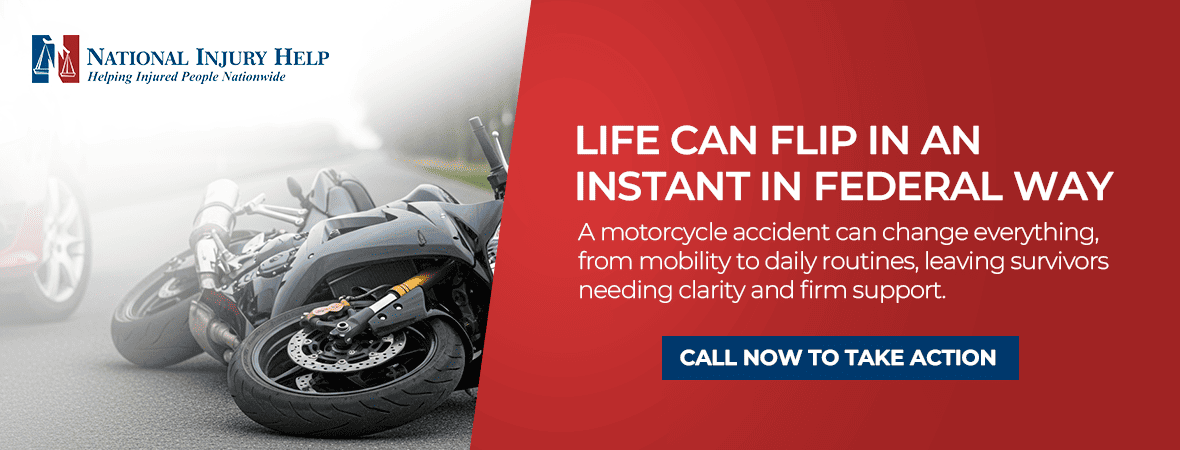
Motorcycle accidents in Federal Way can change lives in seconds. Riders face unique dangers on local highways and city streets, often resulting in catastrophic injuries and long-term financial hardship. When negligent drivers, poor road maintenance, or unsafe conditions cause a collision, victims deserve strong legal representation that understands both Washington law and the local landscape.
Motorcyclists in Federal Way navigate a transportation network that includes Pacific Highway South (SR-99), Interstate 5, and Highway 18: routes known for heavy traffic, fast-moving vehicles, and unpredictable driving behavior. These conditions create a heightened risk for collisions, especially when visibility drops or distracted drivers fail to yield. A serious crash not only leads to physical injuries but also triggers a chain of legal, financial, and emotional challenges that can overwhelm victims and their families.
National Injury Help connects motorcycle accident victims with skilled legal support to ensure those challenges are met with a focused strategy and a strong commitment to recovery.
Understanding Motorcycle Accident Risks in Federal Way
Federal Way’s Traffic and Road Conditions
High-traffic corridors increase crash exposure. Merging lanes and commuter congestion create dangerous conditions.
Federal Way sits at the crossroads of several major transportation routes, including Pacific Highway South (SR-99), I-5, and Highway 18. These high-traffic corridors see thousands of daily commuters traveling between Seattle, Tacoma, Kent, and neighboring communities. Heavy traffic, frequent merging, and sudden lane changes create conditions where motorcyclists face elevated crash risks.
Unlike drivers in enclosed vehicles, motorcyclists have minimal protection. When a crash happens at freeway speeds, the impact often leads to life-altering injuries. Congestion near South 348th Street, retail corridors around The Commons at Federal Way, and frequent construction zones further increase the likelihood of collisions.
No Fee Guarantee: You pay nothing unless we win your case and secure compensation for you.
Call for a Free Consultation
Crash Frequency and Local Statistics
Motorcyclists represent a disproportionate share of statewide fatalities—wet conditions in King County increase accident severity.
Data from the Washington Traffic Safety Commission reveals that motorcyclists make up roughly 15% of statewide traffic fatalities, despite representing a much smaller portion of total registered vehicles. In King County, wet roads and low visibility during the rainy season contribute to many of these incidents.
Crashes often occur during peak commuting hours when traffic flows toward Seattle and Tacoma. Sudden braking, distracted driving, and reduced visibility frequently combine to create dangerous situations for riders. These patterns make Federal Way a high-risk area for motorcycle crashes year-round.
Common Causes of Motorcycle Crashes
Driver Negligence
Left-turn and merging collisions are common. Distracted and impaired drivers often overlook riders.
Driver error accounts for a large share of motorcycle collisions. Many motorists fail to check blind spots or yield properly at intersections. On Highway 18 and SR-99, left-turn accidents occur when drivers misjudge a rider’s speed. Sudden lane changes near the I-5 exits at South 320th Street often lead to sideswipe or rear-end crashes.
Distracted driving remains one of the top contributing factors. Drivers using mobile phones or multitasking behind the wheel frequently overlook smaller vehicles like motorcycles. Impaired driving, especially during late-night and weekend hours, further increases the severity of crashes in the region.
Road and Environmental Hazards
Poor road conditions often lead to single-vehicle crashes. Commercial traffic debris creates hidden dangers.
Road conditions can also contribute to motorcycle accidents. Potholes, uneven pavement, and loose gravel on Enchanted Parkway can cause riders to lose control. Debris from commercial traffic near The Commons at Federal Way creates additional hazards.
Under RCW 46.61, drivers must maintain safe following distances and operate with due care. However, environmental conditions often require extra caution, and failure to adjust to rain or darkness can lead to devastating results for motorcyclists.
Types of Motorcycle Accident Injuries
Life-Altering Physical Trauma
High-speed impacts often cause catastrophic injuries. Motorcyclists lack the protective structure of passenger vehicles.
Motorcycle crashes frequently cause catastrophic injuries. Unlike occupants in cars or trucks, riders lack structural protection, making the human body absorb most of the impact. Common injuries include traumatic brain injuries, spinal cord damage, complex fractures, crush injuries, and severe road rash.
Collisions along I-5 or SR-99 at highway speeds often involve multiple impacts, leaving victims with permanent disabilities. Even lower-speed accidents can result in broken bones, ligament damage, and concussions.
Long-Term Medical and Financial Impact
Extended recovery periods increase financial strain. Helmet laws reduce but don’t eliminate serious injury risks.
Survivors of serious motorcycle crashes often need months or years of medical treatment. Rehabilitation at specialized facilities in Seattle or Tacoma can involve physical therapy, multiple surgeries, and adaptive care.
Washington’s helmet law (RCW 46.37.530) reduces the risk of fatal injuries but cannot eliminate severe trauma. Long recovery periods often result in lost income, increased medical expenses, and emotional strain. These consequences underline the importance of securing full and fair compensation.
Liability in Federal Way Motorcycle Accidents
Identifying Responsible Parties
Multiple parties may share fault. Commercial carriers and public entities often play a role.
Motorcycle accidents often involve more than one negligent party. Common defendants include distracted or impaired motorists who fail to yield, commercial trucking companies operating on I-5, or public entities responsible for unsafe roadway conditions. In some cases, motorcycle or parts manufacturers may face liability for defective components that contributed to the crash.
An effective legal strategy begins with identifying all responsible parties early. Thorough investigation ensures no source of accountability is overlooked.
Comparative Negligence in Washington
Washington allows recovery even with partial fault. Strong evidence builds stronger claims.
Under RCW 4.22.005, Washington follows a pure comparative negligence rule, allowing injured motorcyclists to recover compensation even if they share some fault. For example, a rider found 20% at fault can still recover 80% of the damages.
Establishing liability requires demonstrating duty of care, breach, causation, and damages. Helmet cam footage, dashcam recordings, Federal Way Police Department reports, and eyewitness statements play an essential role in building a strong case.
Legal Process After a Motorcycle Crash
Immediate Post-Accident Steps
Early documentation can shape the outcome of a claim. Emergency response creates crucial evidence.
The first hours after a crash are crucial. Riders should call emergency services, seek medical attention, and document the scene thoroughly. Photos of the crash site, road conditions, vehicle damage, and visible injuries strengthen future legal claims.
Reporting the collision to law enforcement also creates an official record. Statements from responding officers often provide key details about fault and traffic violations.
Investigation and Evidence Collection
Strong evidence increases negotiation leverage. Accident reconstruction clarifies fault.
Once emergency concerns are addressed, the legal process moves into the investigation stage. This step involves collecting every available piece of evidence to build a comprehensive case. Attorneys typically review traffic camera footage, obtain official police reports from the Federal Way Police, and interview witnesses.
Accident reconstruction experts may analyze skid marks, vehicle damage, and environmental factors to pinpoint liability. When commercial vehicles or unsafe road conditions play a role, identifying additional responsible parties becomes essential. A detailed investigation often sets the tone for the entire claims process and strengthens the injured rider’s legal position.
Filing the Insurance Claim
Early filing starts the negotiation clock. A well-documented claim prevents delays.
Once evidence is secured, the injured party can file a claim with the at-fault driver’s insurance company. In Washington, RCW 46.61 governs traffic responsibilities, and violations often serve as a clear basis for liability. Detailed medical records, repair estimates, and witness statements help ensure the claim accurately reflects the true scope of damages.
Insurance adjusters often attempt to minimize payouts. They may question the extent of injuries or argue shared fault. A strong, well-prepared claim limits these tactics and increases the chances of securing fair compensation early in the process.
Negotiation and Settlement Efforts
Most motorcycle accident cases settle before trial. Preparation shifts leverage toward the injured rider.
The negotiation phase typically follows claim submission. Insurers often make initial offers that undervalue medical costs, lost wages, and long-term care needs. A thorough legal strategy prevents riders from accepting lowball settlements.
During negotiations, attorneys present evidence of liability and detailed damage calculations to push for fair compensation. If the insurer refuses to offer a reasonable amount, litigation becomes a necessary next step. Effective negotiation saves time and resources, but trial preparation ensures the insurer takes the claim seriously.
Filing a Lawsuit
RCW 4.16.080 sets a three-year filing deadline. Timely action preserves the right to seek compensation.
If negotiations stall, filing a lawsuit in King County Superior Court keeps the claim moving forward. The lawsuit initiates formal legal proceedings and ensures the case progresses before Washington’s three-year statute of limitations expires.
This stage involves drafting the complaint, serving defendants, and setting discovery deadlines. Filing a lawsuit often pressures insurers to reevaluate their settlement position, primarily when strong evidence supports the rider’s claim.
Discovery and Pre-Trial Preparation
Depositions and expert testimony build a strong case. Full disclosure clarifies liability and damages.
During discovery, both sides exchange evidence and conduct depositions. Accident reconstruction experts, medical specialists, and economic analysts may provide testimony to support the rider’s claim for damages. This process often reveals weaknesses in the defense’s case.
Pre-trial preparation involves organizing exhibits, outlining witness testimony, and finalizing settlement demands. A well-prepared case increases the likelihood of either a fair settlement or a strong trial outcome.
Trial and Resolution
Trials secure compensation when negotiations fail. Jury verdicts often reflect the actual cost of serious injuries.
When settlement discussions don’t result in fair compensation, the case proceeds to trial. During trial, legal teams present evidence, cross-examine witnesses, and argue liability before a judge and jury. Motorcycle accident trials in King County often involve complex liability issues, especially when multiple vehicles or commercial carriers are involved.
A successful trial verdict can include compensation for medical expenses, lost income, pain and suffering, and long-term care needs. In wrongful death cases, the court may also award damages to surviving family members under RCW 4.20.
Compensation for Motorcycle Accident Victims
Understanding the Value of a Motorcycle Accident Claim
Compensation covers both financial losses and quality-of-life impacts. A thorough claim calculation ensures no category of damages is overlooked.
Motorcycle crashes in Federal Way often lead to severe injuries, long rehabilitation periods, and significant financial strain. Victims typically face not just medical bills but also lost wages, damaged property, and long-term care needs. Compensation aims to help riders and their families regain financial stability and rebuild their lives.
Under Washington law, injured motorcyclists can pursue both economic and non-economic damages. Courts and insurers evaluate medical records, expert testimony, and evidence of financial loss to determine fair compensation. A carefully structured legal strategy ensures every eligible damage category receives proper valuation.
Economic Damages
Covers measurable financial losses. Includes medical care, lost income, and property damage.
Economic damages represent the tangible financial costs caused by the crash. These losses are calculated with receipts, bills, wage statements, and expert evaluations. Motorcycle accident victims in Federal Way often face high medical expenses at facilities in Tacoma, Seattle, or King County due to the severity of their injuries.
Common types of economic damages include:
- Emergency room and hospital care, including surgeries and follow-up appointments
- Rehabilitation and physical therapy costs
- Prescription medications, mobility aids, and assistive devices
- Lost wages from missed work during recovery
- Reduced future earning capacity for riders with permanent disabilities
- Motorcycle repair or replacement costs
Economic damages play a central role in settlement negotiations because they provide clear, documentable evidence of loss. Accurately calculating these costs ensures victims don’t accept an undervalued offer.
Non-Economic Damages
Addresses pain, suffering, and emotional distress. Reflects the human cost of a serious crash.
Non-economic damages compensate victims for losses that cannot be measured with invoices or pay stubs. These damages recognize the impact of pain, loss of independence, and emotional trauma following a life-altering motorcycle accident.
Examples of non-economic damages include:
- Physical pain and chronic discomfort
- Emotional distress, anxiety, or depression
- Loss of enjoyment of daily activities and hobbies
- Scarring, disfigurement, or reduced quality of life
- Strain on family relationships and personal identity
Washington law does not impose a statutory cap on non-economic damages in personal injury claims, unlike some other states. This gives juries and insurers flexibility to assign a value that reflects the actual human impact of a catastrophic crash. Experienced legal teams often use testimony from medical professionals, mental health experts, and family members to document these losses convincingly.
Wrongful Death and Catastrophic Loss
- RCW 4.20 allows eligible families to pursue compensation after a fatal crash.
- Damages often include both financial support and emotional loss.
When a motorcycle accident results in death, surviving family members can file a wrongful death claim under RCW 4.20. Compensation may cover funeral and burial expenses, lost future earnings, medical costs incurred before death, and loss of consortium.
Families in Federal Way often face sudden financial and emotional hardship after losing a loved one. A wrongful death claim helps secure the resources needed to manage these losses and hold negligent parties accountable. Courts may also consider the emotional suffering of surviving spouses, children, or dependents when determining compensation.
Maximizing Compensation Through Strong Legal Representation
- Well-prepared claims produce higher settlement offers.
- Expert testimony and documentation strengthen the case.
A comprehensive legal strategy ensures that both economic and non-economic damages receive full consideration. National Injury Help connects victims with skilled attorneys who work with medical providers, economists, and rehabilitation specialists to project future costs accurately. They also highlight the personal and emotional toll of the crash to support non-economic damage claims.
Insurance companies often try to downplay long-term consequences or argue partial fault. An experienced legal team counters these strategies with clear evidence, expert opinions, and a structured claim presentation. This approach increases the likelihood of securing a full and fair settlement or a favorable trial verdict if negotiations fail.
Unique Challenges in Motorcycle Claims
Bias Against Motorcyclists
- Insurance companies may assume that riders share full fault due to stereotypical bias against riders.
- Stereotypes about “reckless riding” often reduce early settlement offers.
Motorcyclists often face an uphill battle because insurers and some jurors bring preconceived notions to the table. Adjusters may argue that a rider “assumed the risk” by operating a motorcycle on busy Federal Way corridors like SR-99, I-5, or Highway 18. These biases can lead to lower initial settlement offers or increased scrutiny of the rider’s behavior.
Skilled attorneys counter these assumptions by documenting safe riding practices, reviewing training records, and presenting evidence from helmet cams or expert witnesses. Demonstrating that the rider followed traffic laws, used safety gear, and exercised reasonable caution helps shift focus onto the negligent driver or responsible party.
Complex Multi-Party and Technical Issues
Multiple defendants often appear in serious crashes. Expert analysis is essential to clarify liability and damages.
Crashes in Federal Way, especially along major highways or near I-5 interchanges, frequently involve more than one vehicle. Commercial trucks, public vehicles, and cars can all contribute to collisions, creating complex liability issues. In these situations, insurers often attempt to argue shared fault to minimize payouts.
Attorneys often work with accident reconstruction experts, medical professionals, and road safety engineers to untangle these complexities. Technical evidence, such as skid marks, vehicle telemetry, or construction zone documentation, can prove which party acted negligently. Multi-party claims also require careful coordination among multiple insurance companies to ensure the victim receives full compensation for all damages.
Weather and Environmental Complications
- Rain, fog, and poor road conditions in King County increase crash risks.
- Environmental factors often complicate liability assessments.
Federal Way experiences frequent rainfall, creating slippery roads that can contribute to motorcycle accidents. Poor visibility, debris from commercial traffic, and construction zones further increase risk. In legal disputes, insurers may attempt to argue that weather conditions or wet pavement absolve them of full responsibility.
Attorneys counter these claims by showing that other drivers failed to adjust their speed or maintain proper distances under the same conditions. Documenting road conditions at the time of the crash, using weather reports and photographs, helps establish negligence despite environmental challenges.
Handling Insurance Company Tactics
- Adjusters may pressure victims into early, low settlements.
- Early legal involvement prevents rushed decisions that reduce compensation.
Insurance companies often attempt to resolve motorcycle claims quickly, especially in cases with visible injuries but uncertain long-term effects. They may request recorded statements, minimize medical reports, or blame the rider entirely. Without experienced counsel, victims risk accepting settlements that do not cover future medical expenses, lost wages, or long-term disability.
Legal representation ensures communication with insurers occurs strategically. Attorneys handle all negotiations, document injury severity, and prepare evidence for trial if necessary. This approach maximizes settlement value and ensures the rider is not unfairly disadvantaged.
How Skilled Legal Representation Strengthens a Case
Strategic Investigation and Evidence
- Accident reconstruction and medical experts add strength.
- Thorough documentation increases settlement value.
Strong motorcycle accident cases rely on comprehensive documentation. Legal teams may work with accident reconstruction specialists, medical experts, and vocational analysts to calculate long-term damages. This level of preparation helps build a compelling claim that insurers cannot easily undervalue.
Evidence such as skid mark analysis, helmet cam footage, surveillance video, and vehicle telematics often determines fault and damage value.
Experience in Local and Statewide Litigation
- Local court familiarity helps streamline claims.
- Proven results build confidence and leverage.
National Injury Help connects motorcycle accident victims with attorneys who bring years of experience handling catastrophic motorcycle injury claims throughout King County and Washington State. Familiarity with local courts in Kent and Seattle allows them to anticipate procedural hurdles and move cases forward efficiently.
Their track record includes significant settlements and verdicts for injured riders, including those facing permanent disabilities or wrongful death claims. This experience ensures clients receive strategic, informed, and relentless advocacy.
Taking the Next Step Toward Recovery
Immediate Protective Actions
Early steps can shape legal outcomes. Accurate documentation strengthens claims.
The steps taken after an accident can shape the entire claim. Injured riders should:
- Seek immediate medical care and follow all recommended treatments
- Photograph injuries, damage, and roadway conditions
- Avoid giving recorded statements to insurers without legal counsel
Prompt action preserves crucial evidence and strengthens negotiating power during the claims process.
Legal Support for a Stronger Outcome
At our firm, we understand that early legal assistance is crucial for maximizing your compensation following a motorcycle accident. We are dedicated to providing you with a focused strategy that allows you to prioritize your recovery while we handle all legal aspects of your case. Our team is equipped to conduct a thorough investigation into the details of your accident and will take charge of negotiating with insurance companies on your behalf. This proactive approach ensures that all Washington legal deadlines are met, giving you peace of mind during a challenging time.
We recognize the tactics that insurance adjusters may employ to minimize damages or unfairly shift blame onto victims, and we are committed to defending your rights against these practices. Our experienced attorneys will work tirelessly to build a strong case that supports your claims and helps secure the compensation you deserve. With our firm by your side, you can focus on healing while we fight for maximum accountability from those responsible for your injuries.
At National Injury Help, we believe that every motorcycle accident victim deserves experienced representation tailored to their unique situation. We are here to support injured motorcyclists and their families every step of the way, ensuring that you have the resources and advocacy needed to navigate this difficult journey. Don’t hesitate to reach out to us for a consultation; let us help you pursue the compensation and justice you deserve. Contact us today to discuss your case!.